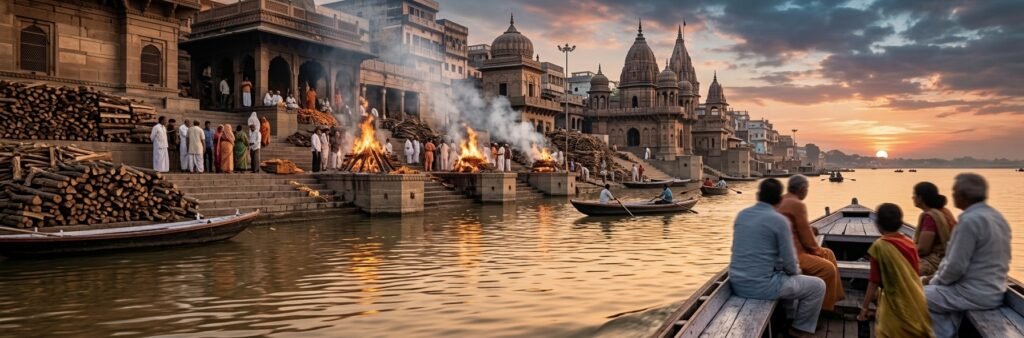
Two people sit in the same boat on the Ganga, watching the same funeral pyres burn at Manikarnika Ghat. One writes afterwards about the meaning of life and death. The other writes about Lord Shiva, Parvati and the promise of moksha. Same fire, very different experiences.
That contrast is the heart of a study I co-authored with Abhisek Porya and Nimit Chowdhary, published in Tourism Analysis (2024). We read 760 TripAdvisor reviews of Varanasi’s main cremation ghat with text-mining tools and asked a simple question: do Indian and international visitors experience this place differently? The short answer is yes, and in ways that matter for how we think about “dark tourism.”
A tourist site that was never built for tourists
Manikarnika Ghat is not a museum or a memorial. It is a working cremation ground where funerals happen around the clock, as they have for centuries. Yet it draws a steady stream of visitors, from Hindu pilgrims to backpackers seeking something profound.
Researchers call travel to places linked with death “dark tourism”: think Auschwitz, Ground Zero or the Chernobyl exclusion zone. Most of that research comes from Western settings and from purpose-built sites. A living cremation ground in India is an unconventional case. Nobody curated it for visitors, and its meaning depends heavily on who is looking.
How we listened to 760 visitors
We collected every English-language TripAdvisor review of Manikarnika Ghat up to October 2022: 760 reviews and about 60,000 words, written between 2011 and 2022. Of the reviewers, 348 were from India, 344 from other countries (led by the US, UK and Australia), and 68 didn’t say.
We then let the text speak in three ways:
- Sentiment analysis scored each sentence as positive or negative, then averaged it per review.
- Emotion detection counted words tied to eight basic emotions: trust, anticipation, joy, surprise, sadness, fear, anger and disgust.
- Topic modelling (structural topic modelling in R) grouped words that tend to appear together into nine themes, and showed which themes each group of visitors leaned on.
Think of it as reading all 760 reviews at once and asking: what do people keep coming back to, and how do they feel about it?
Finding 1: Two groups, two ways of seeing
The topic model found nine recurring themes, and Indian and international visitors split cleanly across them.
International visitors wrote most about the view from the boat, about “experiencing death” as the culmination of life, and about locals asking for money. Their reviews read like existential reflection: a rare, unfiltered look at mortality that their own societies tend to hide in hospitals and funeral homes.
Indian visitors wrote most about Hindu final rites, the mythology of Lord Shiva and Parvati, and the ghat as a holy spot. For them, the fire is not a spectacle of death but a doorway: cremation here is believed to grant moksha, liberation from the cycle of rebirth.
The sociologist John Urry called this the “tourist gaze”: what we see is shaped by the culture we bring. Manikarnika is a near-perfect demonstration. The physical scene is identical; the gaze is not.
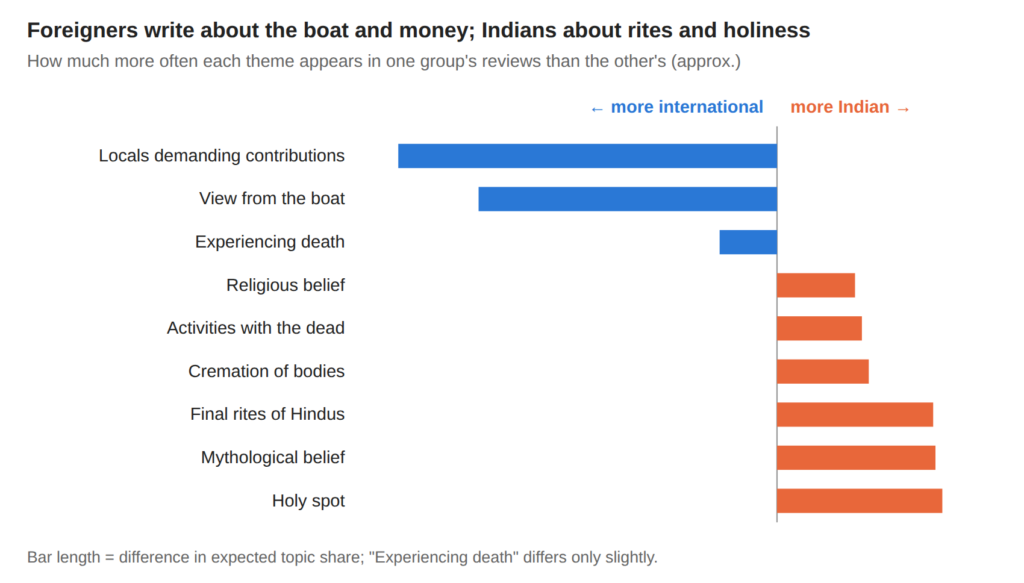
The two biggest gaps are both on the international side: money demands and the boat view. Every theme tied to faith and ritual leans Indian.
Finding 2: Foreign visitors felt more uplifted; Indian visitors felt more disgust
Here is the counter-intuitive part. You might expect outsiders to find a public cremation more disturbing than locals do. The data say the opposite.
International reviews contained more words for all four positive emotions: trust, anticipation, joy and surprise. Their median sentiment was also slightly higher. Negative emotions such as sadness, fear and anger appeared at similar rates in both groups, with one exception: disgust was more common in Indian reviews (2.1 words per review vs 1.7).
One plausible reading: for many foreign visitors the ghat is a once-in-a-lifetime, almost philosophical encounter, so awe and gratitude dominate. Indian visitors hold the site to a sacred standard, so smoke, smell, crowding and uncleanliness register as a betrayal of that holiness.
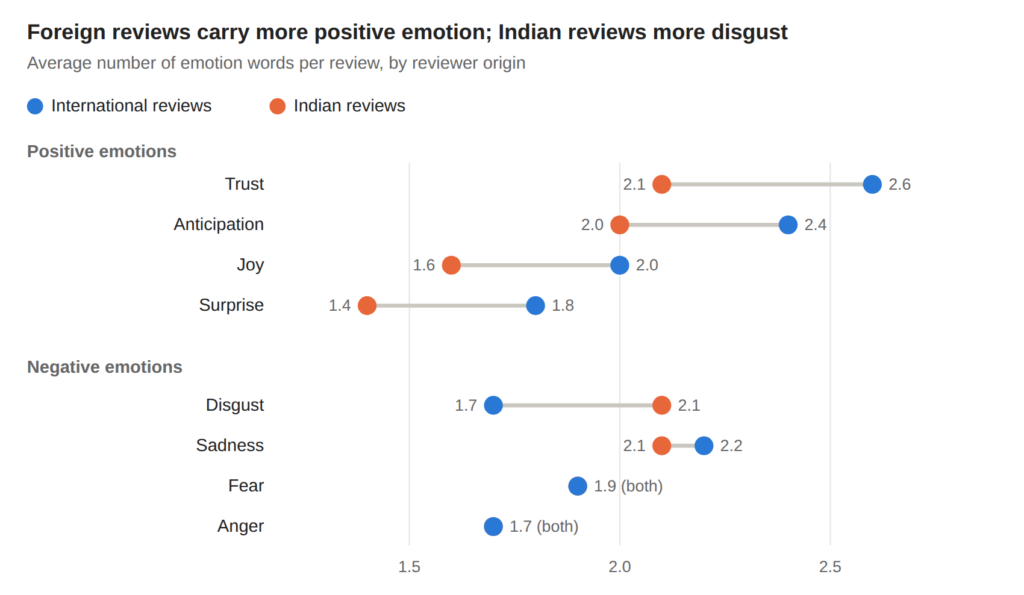
In the top four rows the blue dot sits to the right every time. Disgust is the only emotion where Indian reviewers clearly lead.
Finding 3: The one thing spoiling it is money
The theme that leaned most strongly toward international visitors was not death at all. It was locals demanding “contributions.” Words like money, pay, donation, touts and scam show up repeatedly in foreign reviews.
Interestingly, money and guide were also the most frequent “positive” words in those same reviews. Visitors who found a good guide and gave willingly described it warmly; those pressured for donations described it as the low point of an otherwise profound visit. The difference between a meaningful encounter and a bad one often came down to a single interaction with a local.
Why it matters: a site doesn’t have one level of “darkness”
A well-known framework by Philip Stone ranks dark tourism sites on a spectrum from “darkest” (education-focused, like genocide memorials) to “lightest” (entertainment-focused, like ghost tours). The idea is that each site sits at a fixed point on that scale.
Our results push back on this. Manikarnika Ghat is, at the same moment, a philosophical meditation on mortality for one visitor and a sacred pilgrimage for another. Its “darkness” is not a property of the place. It is something each visitor brings with them, shaped by culture, belief and prior exposure to death rituals.
This also matters because dark tourism research has mostly been written from Western perspectives about Western sites. A non-Western, living ritual space shows how much the field’s categories depend on whose eyes are doing the looking.
What this means on the ground
If one site offers two very different experiences, managing it as one product misses both. The findings point to a few practical moves:
- Tell two stories. Domestic visitors respond to the ghat’s religious and mythological significance; international visitors respond to its philosophical, existential side. Interpretation and promotion can speak to each.
- Invest in guides. Guides shape how visitors understand what they are watching. Intercultural training helps them explain rituals respectfully to outsiders and connect meaningfully with pilgrims.
- Address the money problem with the community. Pressure for contributions was the clearest complaint from foreign visitors. Awareness work with locals can protect both the visitor experience and the dignity of the site.
Read the full paper: Porya, A., Vajpai, G. N., & Chowdhary, N. (2024). Unraveling tourists’ experience of a cremation site: A text mining approach. Tourism Analysis, 29, 187–203. https://doi.org/10.3727/108354224X17048325647329